
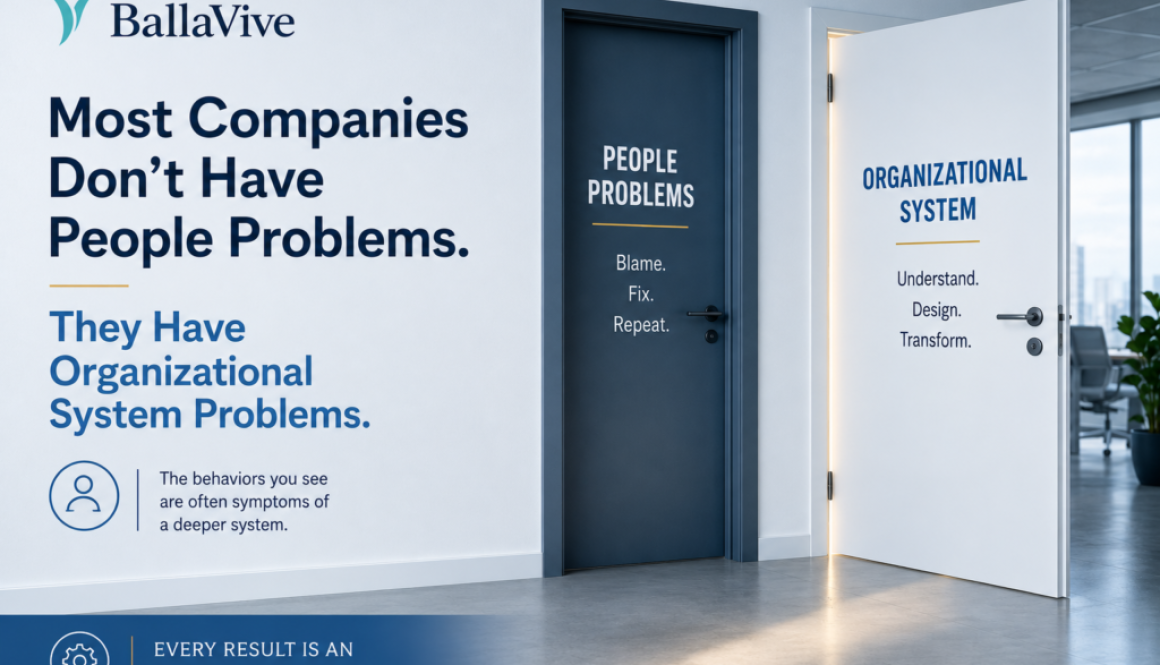
Most Companies Don’t Have People Problems
Why Your Organizational System Is Producing Exactly the Results You’re Getting
By Jim Camic, Managing Partner, BallaVive Leadership Partners
One of the most common things we hear from business leaders is:
“We have a people problem.”
Sometimes they’re talking about turnover. Sometimes it’s accountability, performance, leadership, or employee engagement. The symptoms vary, but the conclusion is usually the same: something is wrong with the people.
In our experience, that conclusion is often wrong. Many organizations are asking the wrong question. Instead of asking, “What’s wrong with our people?” leaders should be asking:
“Why is our organization producing these behaviors?”
That shift in perspective changes everything.
Because most organizations don’t have people problems. They have organizational system problems that show up as people problems.
Every Organization Is Perfectly Designed to Produce Its Current Results
Whether leaders realize it or not, their organization is constantly teaching employees how to behave.
If decisions require multiple layers of approval, employees learn to wait for permission. If managers are rewarded for protecting their department, silos emerge. If mistakes are punished, innovation slows. If accountability is unclear, people focus on activity rather than outcomes.
The behaviors leaders observe every day are often logical responses to the environment they have created.
The organization is producing exactly what its systems are designed to produce.
This is why two companies can hire equally talented employees and achieve dramatically different results. The difference is often not the people. The difference is the system in which those people operate.
Behavior Is Data
When leaders see turnover, disengagement, poor collaboration, resistance to change, or accountability issues, they often view those behaviors as the problem.
What if those behaviors are actually data? People are responding rationally to the system they experience every day.
Employees pay attention to what gets rewarded, what gets punished, how decisions are made, who gets promoted, and what behaviors are tolerated. Over time, the organization teaches people how to succeed within its environment.
The behaviors you see are telling you something about the system. The question is whether leaders are listening.
The Hidden Cost of Organizational Debt
Most business leaders understand financial debt. Borrowing money today creates obligations that must be repaid tomorrow.
What many leaders fail to recognize is that organizations can accumulate another form of debt: organizational debt.
Organizational debt develops when structures, processes, leadership practices, and performance systems no longer support the needs of the business.
Imagine a sales proposal that requires approval from four different leaders before it can be sent to a client. Nobody created the process to slow the business down. Each approval was likely added over time to solve a specific problem.
Today, however, the company loses opportunities while waiting for decisions. Sales becomes frustrated. Customers wait longer. Leaders spend hours reviewing work they should never have to touch.
The organization is now paying interest on organizational debt.
Most growing businesses don’t wake up one morning and choose complexity. They add a process here, a reporting layer there, another approval step, another recurring meeting, another role. Individually, each decision makes sense. Collectively, they create friction that slows execution and limits growth.
Examples of organizational debt include:
- Unclear accountability
- Excessive approval layers
- Conflicting priorities
- Leadership bottlenecks
- Siloed departments
- Poorly defined roles
- Outdated performance systems
- Technology that doesn’t support the work
None of these issues may seem significant on their own. Over time, however, they create costs throughout the organization.
Employees spend more time navigating the system than creating value. Decisions take longer. Meetings multiply. Leaders become overwhelmed. Customers experience delays.
The business pays interest on this debt every day. Unlike financial debt, organizational debt rarely appears on a balance sheet. Yet its impact can be just as significant.
The Business Cost Is Real
Organizations often view workforce issues as HR concerns.
- Turnover is an HR issue.
- Leadership development is an HR issue.
- Performance management is an HR issue.
- Organizational structure is an HR issue.
The reality is far different. These are business issues.
When key employees leave, productivity declines and customer relationships suffer. When managers spend their days resolving internal conflicts, execution slows. When accountability is unclear, performance suffers. When organizational systems cannot scale, growth becomes more difficult and expensive.
Ultimately, these challenges affect revenue, profitability, customer experience, risk, and enterprise value. The cost of organizational system problems is not measured in employee surveys. It is measured in business results.
Looking Beyond the Symptoms
When leaders encounter workforce challenges, the instinct is often to address the visible symptom.
If turnover increases, they focus on retention.
If engagement scores decline, they launch engagement initiatives.
If accountability is weak, they introduce new performance management tools.
Those actions may help, but they often fail to address the root cause.
A better question is:
“Why is a rational employee responding this way within our system?”
If high performers are leaving, what is the organization teaching them about growth opportunities? If managers avoid difficult conversations, what incentives or barriers exist within the system? If employees resist change, what previous experiences have shaped their response?
The answers often reveal more about the organization than they do about the people.
The Future Belongs to Organizations That Design Intentionally
Technology will continue to evolve, and artificial intelligence is already reshaping many aspects of work. New tools will emerge, and new ways of working will follow.
Yet the organizations that thrive will not be defined by technology alone.
They will be defined by their ability to design organizational systems that enable people and technology to work together effectively.
That requires leaders to think differently. Not simply about hiring better people. Not simply about implementing better technology. But about understanding how structure, leadership, processes, performance systems, incentives, and technology interact to produce business results.
Because every outcome an organization produces—good or bad—is an output of the system.
- Revenue is an output.
- Turnover is an output.
- Accountability is an output.
- Customer experience is an output.
- Enterprise value is an output.
At BallaVive, we believe leaders spend too much time asking how to change people and not enough time asking what their organizational systems are teaching people every day.
The question isn’t whether your organization has a system.
The question is whether it’s producing the results you intended.
If your organization’s current results are a product of its system, what would you change first?
About BallaVive Leadership Partners
BallaVive Leadership Partners helps growing organizations redesign how work gets done to maximize performance, accelerate growth, and prepare for the future of work. Through workforce transformation consulting, organizational design, and fractional HR leadership, we help leaders align people, processes, technology, and structure to achieve measurable business results.
Interested in assessing your organization’s readiness for the future of work? Contact BallaVive to schedule a complimentary consultation and learn more about our Future-Ready Workforce Assessment™.